Subterranean termite soil trenching fits slab-on-grade homes and pier-and-beam properties experiencing mud tubes along concrete footings or visible subterranean swarms near wall baseboards. Unlike bait stations that…
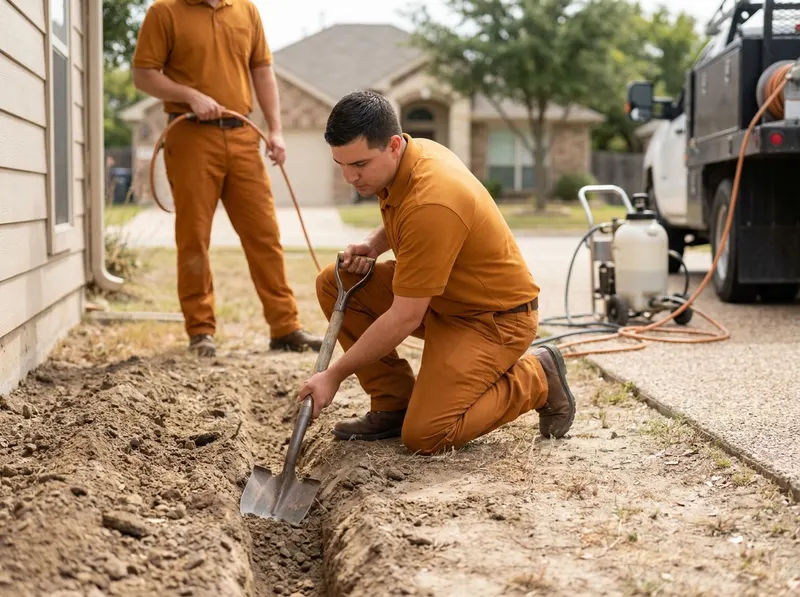
Subterranean termite soil trenching fits slab-on-grade homes and pier-and-beam properties experiencing mud tubes along concrete footings or visible subterranean swarms near wall baseboards. Unlike bait stations that rely on random insect foraging patterns, liquid trench barriers deliver an unbroken treatment boundary that foraging workers unknowingly pass through, transferring active termiticide back to the main colony. The primary trade-off involves minor soil displacement alongside foundation shrub beds or drilling through exterior flatwork like patios, though these access holes are sealed with matching hydraulic mortar immediately after chemical injection.
Properties near the San Jacinto River Bridge, dense timber along the Big Thicket National Preserve boundary area, and the Sam Houston National Forest eastern fringe face elevated moisture gradients that draw subterranean colonies toward exterior mudsills. Sandy loam soils across Lake Water Wheel Estates and Arrowhead Lakes require careful chemical saturation depth calculations to ensure persistent vertical barrier binding. Rather than relying on temporary indoor aerosol sprays that merely scatter insects deeper into wall cavities, precision soil trenching neutralizes structural termite threats directly at the below-ground entry pathway.
Every job gets a firm, written price after a free on-site visit.
Tell us about your subterranean termite soil trenching and treatment job in Shepherd and we'll send a clear, written quote — usually the same day.
 Safe Space Pest Removal